Bio
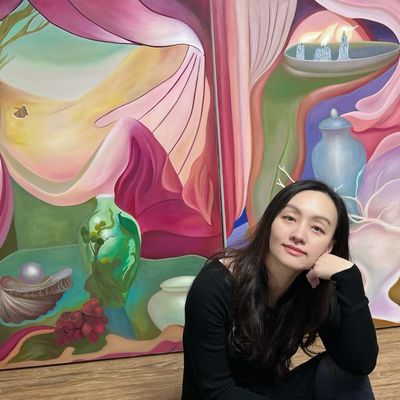
Yuan Butler (b. China) is a visual artist and art professor based in Duluth, Georgia. Working primarily in oil on large-scale canvas and wood panels, she earned an MFA in Painting from the Savannah College of Art and Design after immigrating to the United States in 2014.
Her work draws from early training in drawing and traditional Chinese ink painting, shaping a practice grounded in memory and imagination. Butler has exhibited widely in the United States, and her work is held in both private and public collections. In 2023, she received the Cecile Adler Cliffer Memorial Cutting Edge Award from the National Association of Women Artists. In 2024, her work was featured in New American Paintings, MFA Issue 171. In 2025, her series Four Seasons was acquired into the permanent collection of the SCAD Museum of Art. In early 2026, her work was juried into New South 7 exhibition in Kailin Art.
Statement
My paintings are informed by memory, interior experience, and the slow accumulation of time. For many years, I learned to hold emotion internally, allowing unspoken moments to surface gradually through color, form, and spatial relationships. Painting functions not as representation, but as a method of return—toward experiences that persist despite distance, silence, or erosion.
Migration and shifting identities shape my practice through cycles of displacement and reorientation. Art-making has become a means of gathering what has been fragmented, restoring continuity through sustained attention and care.
My visual language draws from both Eastern and Western traditions. Early engagement with Chinese traditional landscape painting s introduced spatial philosophies in which restraint and openness generate meaning, while Western painting’s emphasis on layering and light allows emotional content to emerge through material accumulation. These influences coexist in productive tension.
My process is deliberately slow and iterative. Each work develops through layering, pause, and repetition, sustaining emotional states rather than fixed narratives and inviting open-ended interpretation.
CV
